





Restoring Natural Healing in the Eye.

Our lead program is focused on neurotrophic keratitis (NK), a rare ocular surface disease where loss of corneal sensation prevents the eye from detecting injury and initiating repair. By targeting the intracellular barrier that stalls healing, we aim to redefine the treatment landscape for patients with limited options today.

When the Eye Can’t Feel, It Can’t Heal

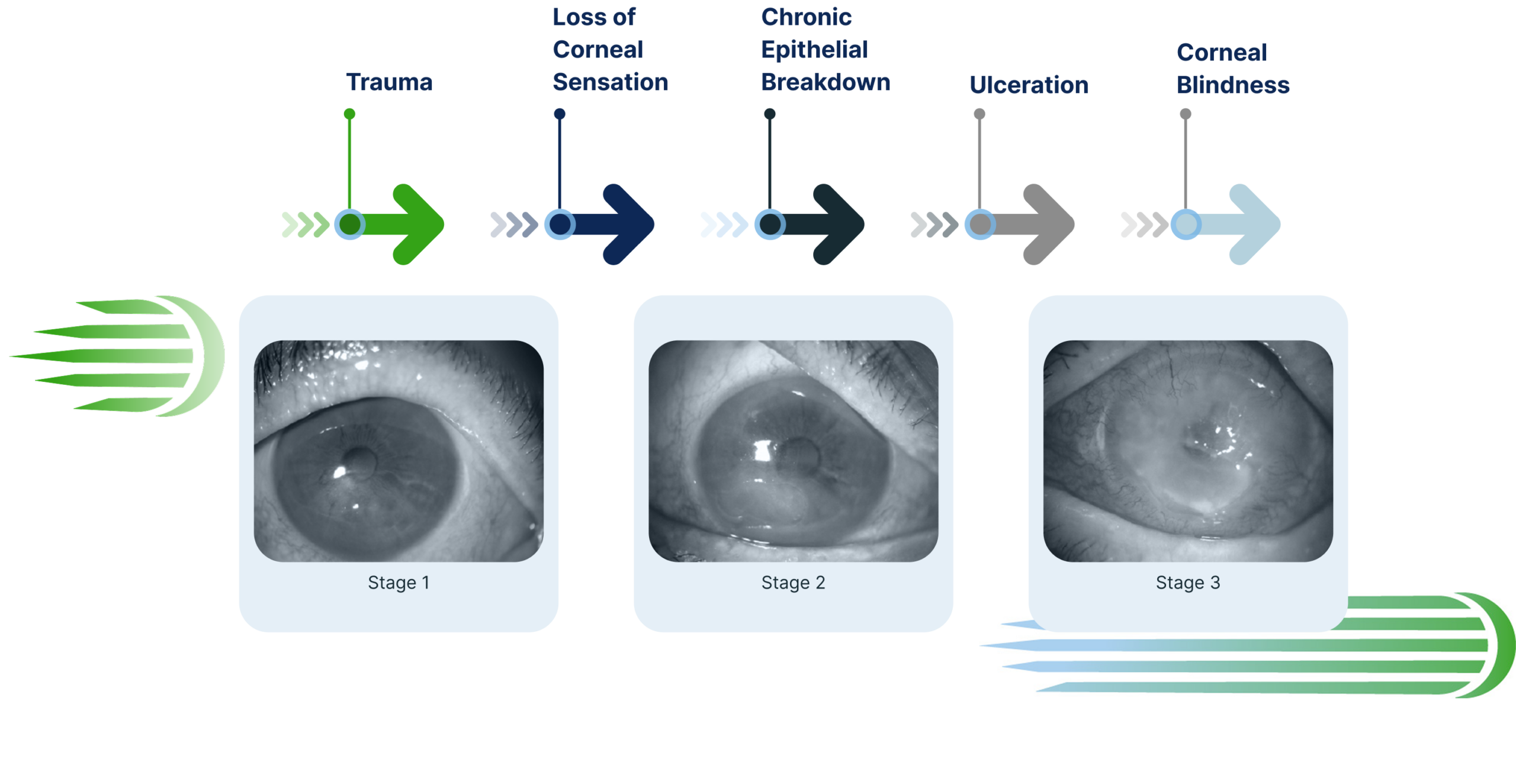
NK is a degenerative ocular surface disease affecting approximately 150,000 people in the U.S., where corneal nerves become damaged and sensation is lost.¹ Without these signals, the eye cannot detect injury or activate the healing processes needed to protect vision.

The result is a progressive condition marked by:

Current therapies focus largely on protection or external stimulation, often with burdensome dosing schedules and variable results. There is a significant need for a treatment that restores the biology of healing itself.

1. Dana R, et al. Neurotrophic keratopathy: Epidemiology and prevalence. StatPearls [Internet]. 2023.
Why NK Is Our First Focus

A Clear Opportunity to Demonstrate Pro-Regenerative Healing

Neurotrophic keratitis represents a clear opportunity to demonstrate the power of pro-regenerative medicine because its underlying biology aligns directly with our intracellular target, FL2. When the cornea loses sensation, the repair process stalls — creating a well-defined need for a therapy that can restore cell movement and support true healing.

The clinical endpoints in NK are clear and measurable, allowing us to translate our preclinical success into meaningful, patient-centered outcomes. By beginning in NK, we can bring real benefit to patients with urgent unmet need while establishing a strong foundation for expanding our platform across other tissues.

MCR-231: Restoring Natural Healing Through FL2 Inhibition

MCR-231 is a topical, pro-regenerative siRNA therapy engineered to temporarily silence FL2, the intracellular enzyme that blocks cell movement after injury.

Here’s how it works:

Faster Epithelial Closure3

Temporarily silences the intracellular enzyme that restricts cell movement and stalls healing.

Reactivates Natural Repair

Restores coordinated epithelial migration and supports corneal nerve regeneration.

Localized, Non-Systemic Delivery

A proprietary topical siRNA formulation designed to act where it’s needed — with no systemic exposure detected.

Built for Real-World Use

Room-temperature stability and every-other-day dosing simplify treatment for both patients and clinicians.
Preclinical Evidence

Potential to Accelerate Healing and Restore Nerves

Our robust preclinical program demonstrates that FL2 inhibition meaningfully improves both corneal surface healing and nerve regeneration – These findings support advancement into first-in-human evaluation:

Epithelial Repair

  • 2× faster wound closure in multiple injury models

  • Complete epithelialization in 5 days vs. 10+ days for controls

Nerve Regeneration

  • 75% increase in nerve density compared to untreated eyes

  • Restoration of nerve architecture comparable to uninjured controls

Safety

  • No systemic siRNA detected

  • Clean ocular tolerability

  • Temporary, self-resolving activity

Tissue Quality

  • Improved clarity

  • Reduced scarring

  • Normal tissue morphology restored
Other Eye Applications

Expanding MCR-231’s Potential Across Ocular Injury

While neurotrophic keratitis remains our primary focus, early research suggests that MCR-231 may have broader applications across ophthalmology, particularly in conditions where rapid epithelial repair and nerve restoration are essential – like corneal burns.
Preclinical findings show that MCR-231:

Accelerates corneal re-epithelialization for faster early-stage repair

Improves transparency, reducing edema and scarring

Restores nerve architecture, supporting long-term corneal health

Enhances epithelial structure, with more organized cell layers versus controls

Beyond burns, MCR-231’s mechanism suggests possible relevance in other ocular surface injuries and post-surgical healing environments where improved epithelial closure and nerve recovery could significantly benefit patients.

As additional studies progress, we aim to expand the role of pro-regenerative siRNA therapies across a wider range of vision-threatening conditions.

Interested in Our Work in NK or Pro-Regenerative Healing?

We welcome inquiries from clinicians, researchers, and partners who share our commitment to advancing intracellular, pro-regenerative therapies. Connect with us to explore collaboration opportunities or learn more about our development programs.