Jump To Excisional Wound Repair | Jump To Dermal Burn Repair
Excisional Wound RepairMicroCures’ candidate, MCR-111, is initially being developed for excisional wound repair. In independently conducted and validated preclinical studies, the treatment has consistently demonstrated the ability to significantly accelerate and enhance the repair of excisional wounds.
When compared to control subjects, those animals treated with MCR-111 demonstrated:
- Significant increases in the rate of wound epithelialization
- Significant improvements in skin structure after healing including an increase in the density and organization of mature dermal collagen and enhanced restoration of hair follicles and sweat glands
- Significant improvements in restoration of healthy vasculature
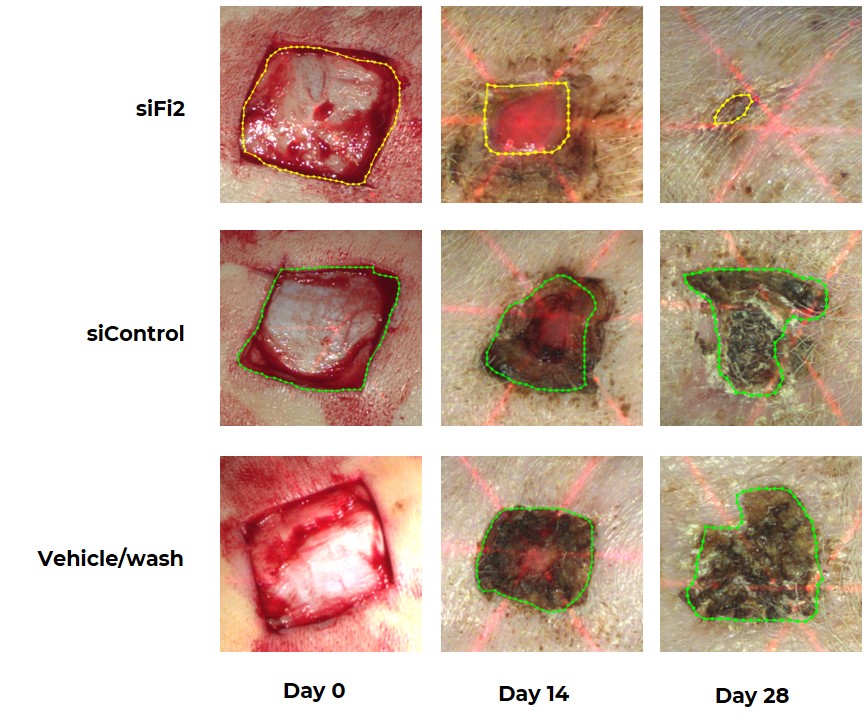
Porcine Excisional Wound Repair Following Topical Treatment with MCR-111, siControl or Placebo Every Other Day for 21 Days
Pigs treated with MCR-111 demonstrated significantly improved and accelerated healing of excisional wounds as compared to both placebo and control subjects. Wounds were measured precisely using 3D laser scanning technology in order to quantify the remaining open area (highlighted within each wound).
MCR-111 Treatment Reduced Wound Area and Significantly Improved Rate of Tissue Repair in Porcine Excisional Wound Model
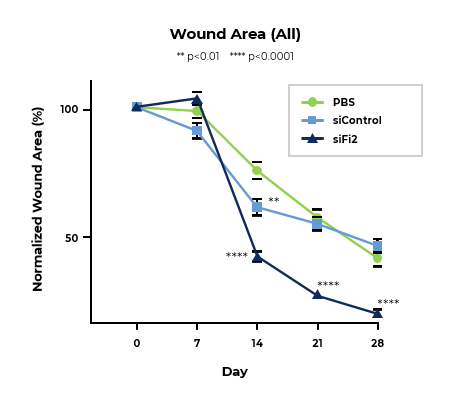
Line graph of normalized wound area at designated timepoints shows MCR-111-treated wounds healed at a significantly improved rate compared to both siControl and placebo.
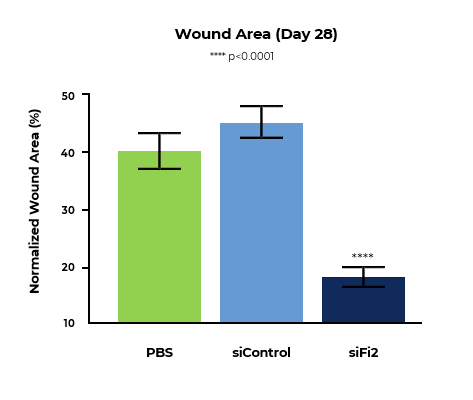
Bar graph of normalized wound area at day 28 shows MCR-111-treated wounds demonstrated statistically significant reductions in wound area of 2.19x and 2.47x compared to placebo and control, respectively.
Based on these promising preclinical findings, MicroCures expects to file an investigational new drug (IND) application for siFi2 in excisional wounds in 2023 and initiate a Phase 1 proof-of-concept trial thereafter.
The potential to transform tissue repair.
Excisional wound repair is a multi-billion dollar market that is inadequately served with current treatment options. MicroCures believes that its proprietary cell movement acceleration platform, led by MCR-111, represents a fundamentally new and disruptive technology. It provides a much-needed alternative to today’s complex, potentially unsafe and often unproven regenerative medicine treatments that are used for wound healing.
MCR-111 is applied topically to the damaged tissue resulting in an accelerated burst of healing, after which the treated cells return to their normal rate of movement within 48 hours with no apparent long-term change to cell behavior. The MCR-111 treatment can be repeated over a multi-day period to optimize speed and quality of tissue repair after injury.
Dermal Burn Repair
MicroCures also is developing MCR-111 as a potential treatment in the area of burn repair.
Data from preclinical studies in pig and mouse burn wound models have consistently demonstrated significantly improved and accelerated repair of burn wounds following treatment with MCR-111. MicroCures has partnered with a CMO to produce 2 GMP compatible formulations which have been tested successfully in the highly relevant porcine burn model. These siRNA delivering formulations are commercially viable to produce.
Pig Full Thickness Burn Study
Week 4:
Necrosis scores for MCR-111-treated subjects were dramatically lower than placebo and control subjects. This reduction in necrotic progression is believed to allow healing while preventing further deepening and expansion of the original burn wound.
Week 6:
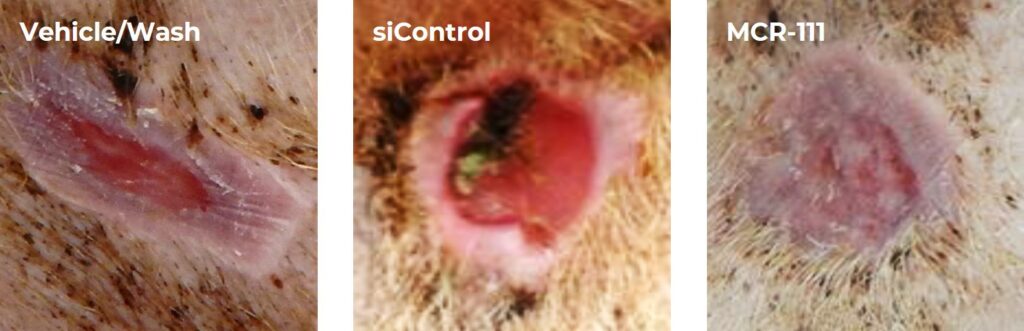
The images below, taken at Week 6, provide clear visual evidence of improved would repair for siFi2-treated subjects as compared to placebo and control.
Week 8:
- 39% of MCR-111-treated wounds were closed as compared to only 11% for control subjects and 0% for placebo
- MCR-111-treated subjects demonstrated a significantly improved rate of repair as measured by epithelial surface measurements vs placebo (p = 0.0106) and control (p = 0.0012)
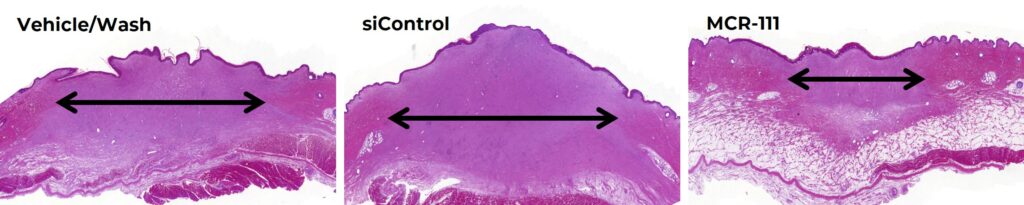
- MCR-111-treated subjects demonstrated greater enhancement in mature collagen as compared to placebo and control
Mouse Full Thickness Burn Studies
When compared to control subjects, those treated with MCR-111 demonstrated:
- Reduced burn size and inflammation
- Improved epidermal thickness and structure, closely resembling unwounded skin
- Enhanced collagen deposition and hair follicle formation, closely resembling unwounded skin
- At week 2, 100% of all MCR-111-treated burns closed completely, while only 75% of placebo and 70% of control subjects had their burns completely closed
Full Thickness Burn Study in MCR-111 in Combination with PluroGel
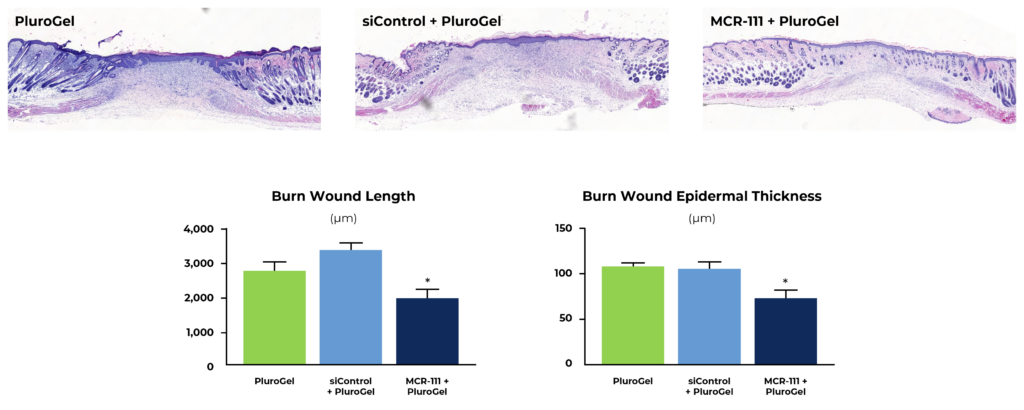
When combined with PluroGel, a commonly used wound and burn dressing, MCR-111 resulted in statistically significant reductions in both burn wound length and burn wound epidermal thickness as compared to PluroGel alone and control. Histology images below show that the wounds treated with the MCR-111 and PluroGel combination demonstrated a structure most similar to unwounded skin.
MicroCures’ burn wound repair program is supported by a two-year, $1.5 million SBIR grant from the National Institutes of Health. This funding is helping advance the program through preclinical studies and toward the clinic.